
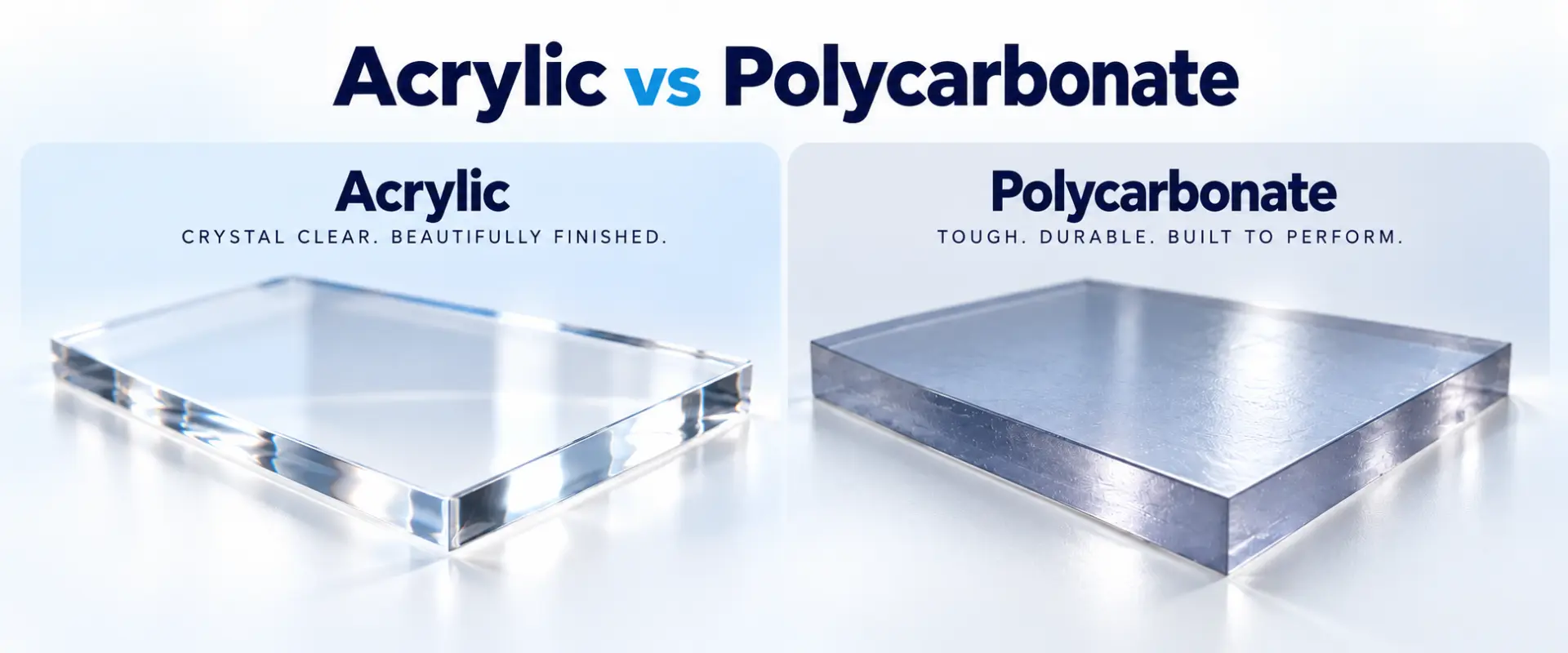
Most people who ask us this question are holding a broken window, a worn machine guard or a quote for a display case, and they want to know which clear plastic to use. Neither acrylic nor polycarbonate is simply better. Each suits different jobs, and the grade of sheet matters almost as much as the plastic itself.
Perspex is generally the better choice when clarity, when clarity, scratch resistance, polishing, outdoor stability and cost matter more. Polycarbonate is more suitable when high impact resistance is essential. We have been cutting, moulding and polishing both plastics in our Henderson workshop for about fifty years. This guide covers the questions we hear most from boat owners, caravan owners, DIYers and trade customers.
Is Perspex acrylic or polycarbonate?
Perspex is a brand name for acrylic (PMMA, or polymethyl methacrylate). Lexan is a brand name for polycarbonate. Many people say “Perspex” for any clear plastic sheet, which is where much of the confusion starts. The two look almost identical on a shelf, but they behave very differently once you cut, drill, bend, fit and use them.
Treating “acrylic” and “polycarbonate” as single materials hides the most useful part of the answer. Each comes in grades that change how it performs:
- Standard cast acrylic: the clear, rigid, polishable sheet most people picture. We supply clear cast acrylic, plus matt, opal, mirror, solid-colour and tinted versions.
- Impact-modified acrylic: acrylic formulated to resist impact better than standard acrylic, for glazing where extra toughness helps.
- Clear polycarbonate: the toughest of the common clear sheets, but with a softer surface.
- Anti-scratch polycarbonate: polycarbonate with an anti-scratch finish, for places where wiping and abrasion are expected.
- Tinted sheet: both plastics come in tints, such as grey, for privacy and glare.
So the real question is rarely “acrylic or polycarbonate?” It is “which grade of which plastic suits this job and this exposure?”
Which should you choose for your project?
Boat windows
Both plastics are used on boats, and the right choice depends on where the window sits. Fixed side windows and portlights that sit in the sun and need to stay clear often suit acrylic. It holds its clarity outdoors, can be polished, and can be moulded to the curve of the original. Windscreens and positions that take heavy knocks or water loads may suit polycarbonate, provided it is a UV-protected grade, ideally with an anti-scratch finish. We list boat windscreens among the uses for Lexan polycarbonate. If your vessel is surveyed, check the survey requirements before choosing a material.
We make replacement boat windows by moulding a new sheet over the original, after repairing and smoothing it, so curved windows are matched closely.
Caravan and motorhome windows
Replacement caravan windows are usually made in acrylic. A double-glazed unit, for example, can use a grey-tinted outer sheet and a clear inner sheet. The original window, even a smashed one, lets us make an accurate template.
DIY panels and replacement glazing
For a clear panel indoors or in a sheltered spot, clear Perspex is usually the simpler, cheaper and easier-to-finish choice. For something that will be kicked, struck or hit by flying objects, such as a play-area panel or a workshop door window, polycarbonate is the safer pick.
Machine guards
Polycarbonate is commonly used for machine guards and covers because of its impact performance. A guard is a safety device, though. The right material, thickness, fixings and design depend on the machine and the hazard, and should be assessed by a competent person against WorkSafe NZ guidance and the relevant standards. Treat this article as general information, not guard design advice. Our machine and safety guards page shows what we make.
What thickness do you need?
There is no single answer. Thickness depends on how large the unsupported span is, how the sheet is held (framed all round or fixed at points), the loads it will see (wind, water, impact, people), and how much weight and flex you can accept. Thicker sheet is stiffer and stronger, but heavier and dearer.
We supply clear acrylic from 2 mm to 50 mm and clear polycarbonate from 1 mm to 12 mm, with impact-modified acrylic and anti-scratch polycarbonate in a narrower range. Full sheets are typically 2440 x 1220 mm, or we cut to size. Check the product pages for current options. For structural, safety or marine jobs, ask us rather than guess, as the thickness may need to come from an engineer or a standard.
If you are unsure, tell us the application, size and where it will be used, and we will recommend a material and thickness and quote for it. Send us your details or call 09 838 5346.